


This site uses cookies – Learn more.
Witch Hazels: A Wintertime Display at Madison Square Park
Witch Hazels: A Wintertime Display at Madison Square Park
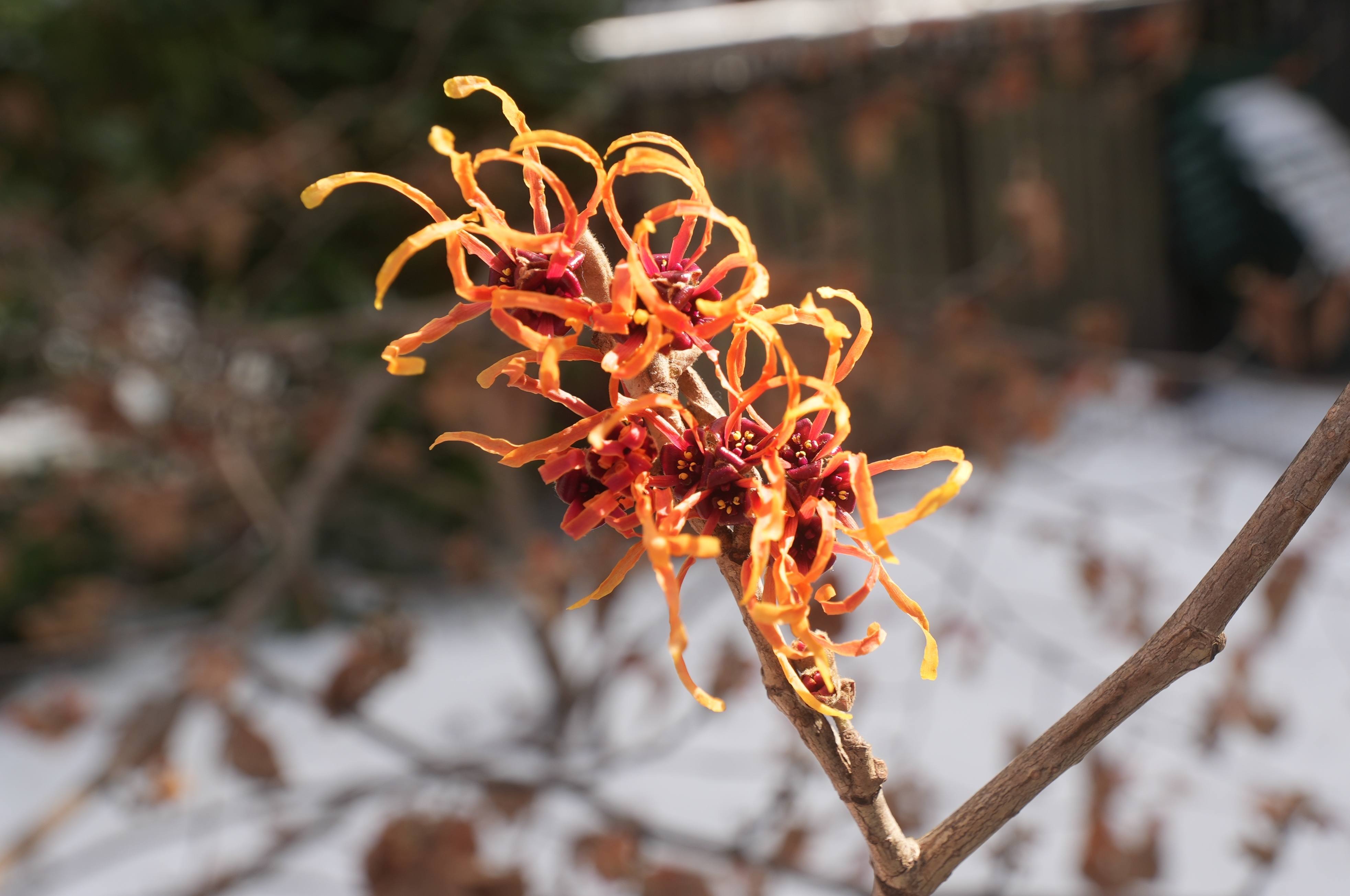


Winter can be a particularly dreary and sad time in our gardens. Most deciduous trees have dropped their leaves and stand bare. The flowers from the previous season have withered, and color is drained from most every plant. One plant that brings a spark of color to this sad scene is Hamamelis, commonly known as witch hazel, which is in abundance across Madison Square Park.
Hamamelis is a genus of flowering deciduous shrub or small tree, some blooming as early as December, continuing till March.Three of the species are native to the Americas, including Hamamelis virginiana, Hamamelis vernalis, and Hamamelis ovalis. The remaining two species, Hamamelis japonica and Hamamelis mollis are natives of Japan and eastern China respectively.
Winter bloom is certainly a unique feature of witch hazels, but the actual reason for this is still not fully understood. One theory is that such an early bloom decreases competition with most other plants that don’t bloom until the spring. Yet, the actual mechanism for their seed dispersal is not fully determined. Some potential pollinators include owlet moths, gnats and late-season bees scavenging for food. Furthermore, witch hazel seed pods explosively dehisce after maturation, splitting open and ejecting seeds with sufficient force to eject them up to 30 feet away.
Some notable varieties that we maintain at the park include Hamamelis x intermedia ‘Jelena’ and Hamamelis x intermedia ‘Robert’, both varieties being a hybrid between Hamamelis japonica and Hamamelis mollis. Jelena de Belder-Kovacic was a Slovenian-Belgian botanist and horticulturist who worked extensively on plant taxonomy and plant preservation. On a visit to the Kort nursery in Belgium, she discovered that the plot had been purchased in 1952 by brothers Robert and Georges De Belder, both motivated by the wish to preserve the collection of ancient trees in danger from a proposed housing project. During her visit, Jelena recommended that Robert try propagating his witch hazel collection by cuttings, rather than transplanting. Their shared love of plants brought them together and they married shortly after meeting, becoming the ultimate witch hazel power couple. Their love is immortalized in the varieties named after them, and subsequent varieties they cultivated, which they named after their beloved friends.
The witch hazel collection at Madison Square Park has grown to over 70 taxa mostly consisting of named cultivars representing all 5 species and is distributed all throughout the park. In 2022 this collection received recognition as a Nationally Accredited Plant Collection by the Plant Collections network, a partnership with the United States Department of Agriculture recognizing this collection as a preservation of plant genetic material.
Come by to see this unique winter bloom here at Madison Square Park before it’s gone.
Written by Devon Phillips, Seasonal Horticulture Intern


